FLEXI-CASA Listing Image Pipeline
Building a Scalable AI Content System for Amazon Listings
A templated system for generating 6-slot Amazon product images at scale — without a design team.
The Constraint
6 images per SKU. Manual production, no repeatable process, bottlenecked by one person. The problem wasn't bandwidth — it was the absence of a system.
Key Decisions
Gemini multimodal over text-only models Text-prompt-only generation hallucinates the product. Passing the actual product image as input was the only path to fidelity.
Figma over Paper MCP for the design layer Paper MCP was faster to iterate in, but Figma's component control and export reliability won at production scale.
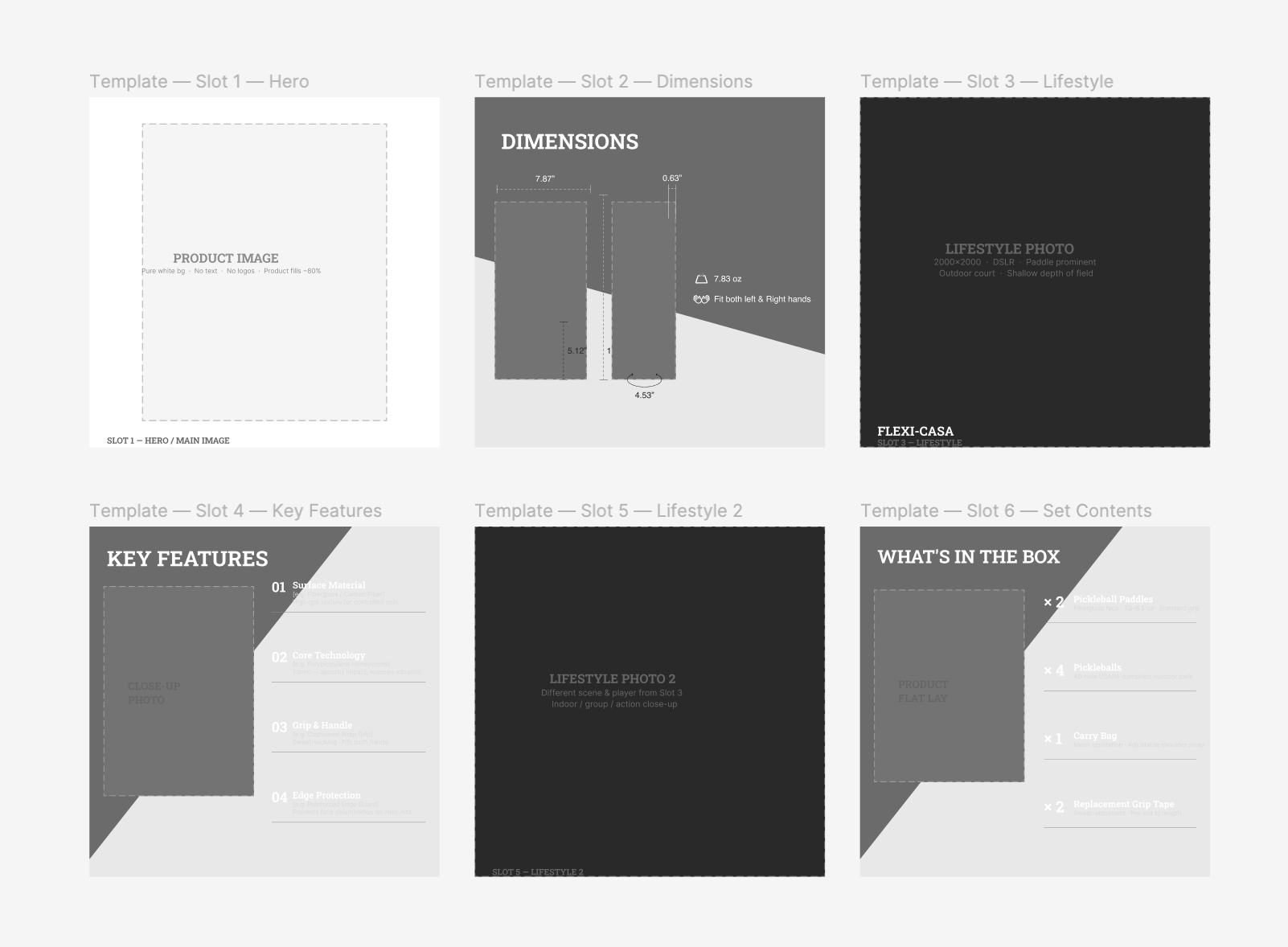
Fixed slot schema, not free-form generation Each slot has a defined job. This is what makes the output auditable and the process repeatable.
6-Slot Template
- 01 — White bg hero: Full product set, Amazon-compliant
- 02 — Dimensions: Annotated measurements
- 03 — Fiberglass surface: Material close-up + callouts
- 04 — Comfort grip: Material + feel descriptors
- 05 — Pro credibility: Brand + tournament positioning
- 06 — Lifestyle: User scenarios, on-court context
Shipped
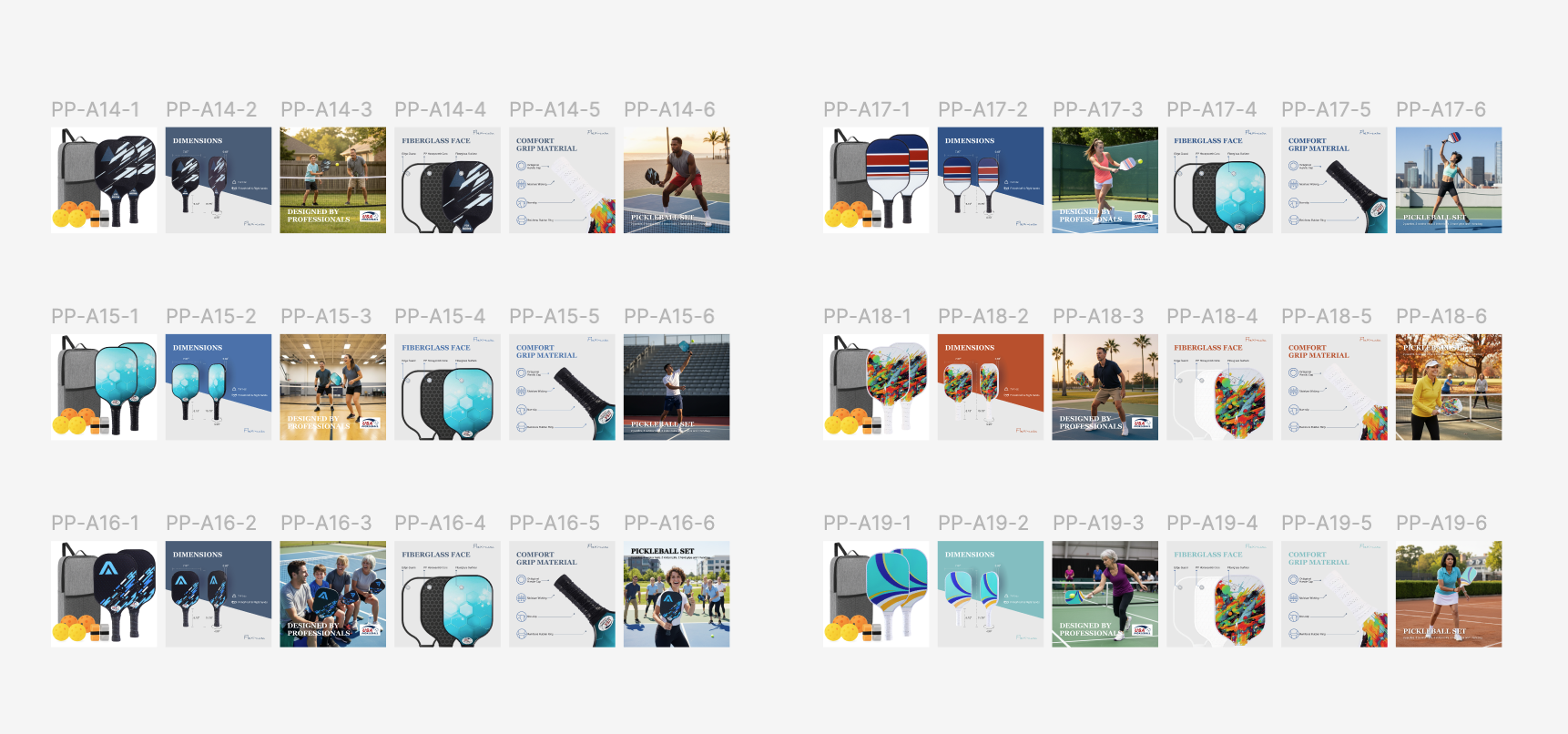
- 36 images — 6 SKUs × 6 slots (PP-A14 through PP-A19)
- Days → hours per-SKU production time
- Figma file: slot wireframe templates, lifestyle references, batch output page
Active Problems
Output quality inconsistent across SKUs Hypothesis: prompt constraints aren't tight enough per slot; source image lighting variance bleeding through.
Slot copy drifts across a listing Each slot is generated independently. Fix in design: a structured per-SKU product brief generated first, feeding all 6 slots from one source of truth.
The Takeaway
AI handles structure and volume. Humans own consistency and judgment. The pipeline works — the next problem is making QA a spot-check, not a rewrite.