Tesla Charging Experience
AI-Driven Product Strategy · PM Interview Case Study · 2026
Overview
Redesigning Tesla's charging experience with AI to reduce driver anxiety, optimize routing, and increase network throughput.
The Problem
China's EV charging network has won the coverage battle (12.8M devices, 98% expressway coverage) but lost the experience one. Drivers face a simple, repeating problem: too much information, too much uncertainty, too many decisions, made alone.
User research surfaced three uncertainties present in every charging session:
- Availability — When I get there, can I actually charge?
- Time — Should I wait? How long?
- Value — Is this the best choice?
The Insight
The real problem isn't missing information. It's that drivers are forced to repeatedly make complex decisions under high uncertainty without help.
The product opportunity is reframing charging from an information lookup tool into a decision system that has an opinion — explainable, accountable, and always dismissible.
The Solution
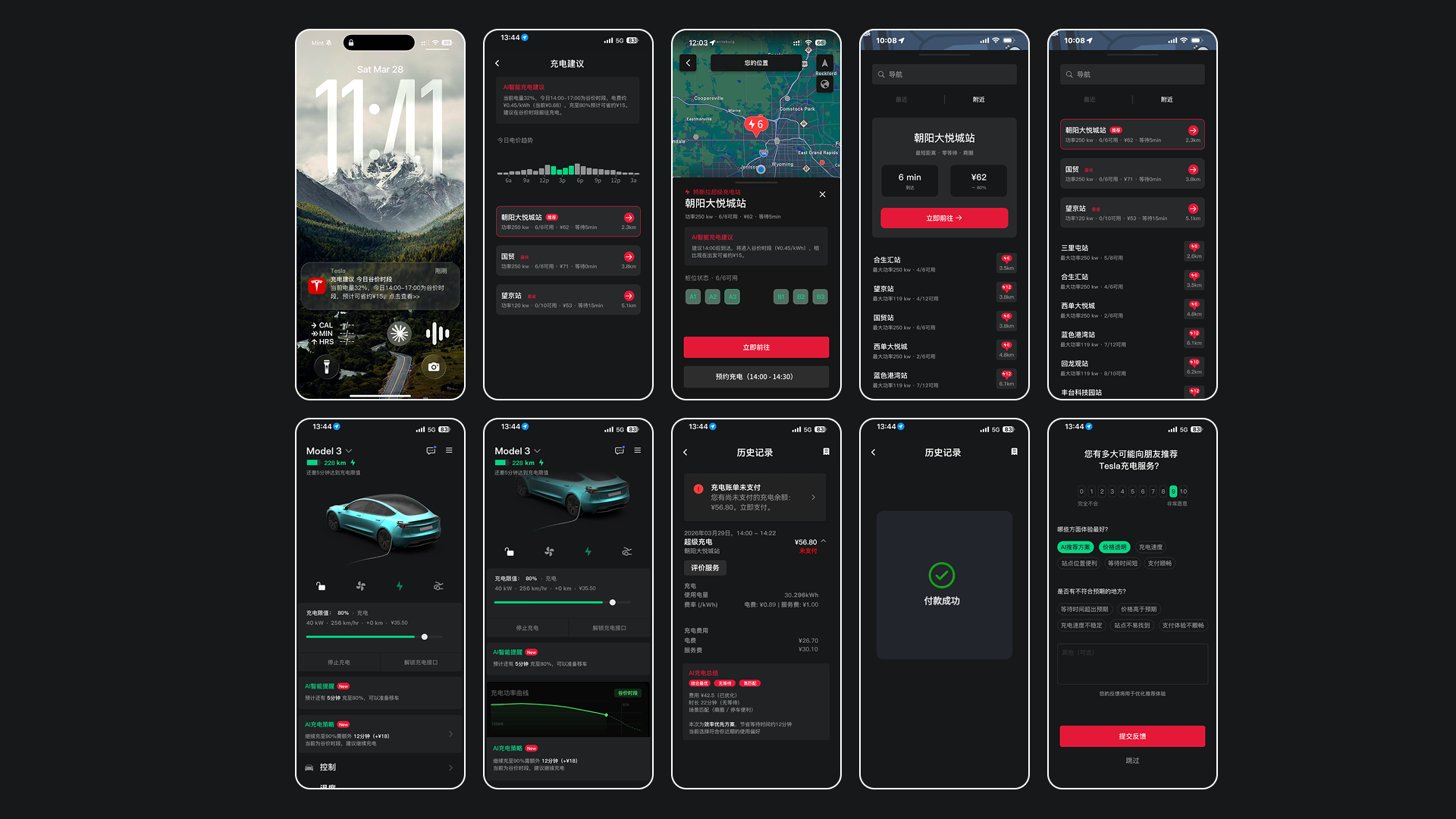
A five-stage AI-driven journey:
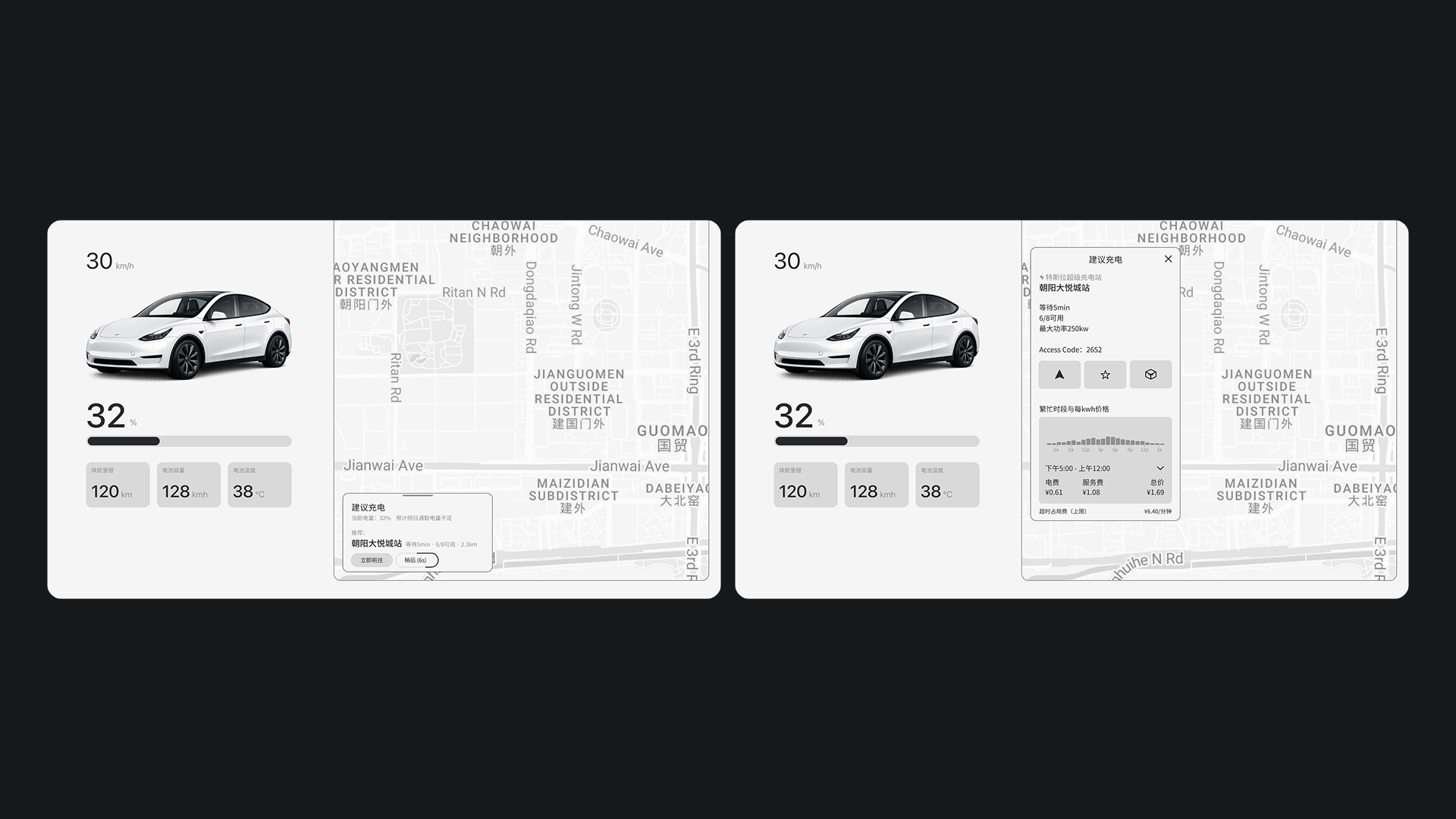
- Sense the need — predict when the user needs to charge from commute and battery patterns; surface a low-interruption recommendation
- Find & decide — generate 2–3 explainable options, ranked by time/cost/fit
- During charging — real-time progress, dynamic strategy hints, move-your-car reminders
- Pay & leave — show the user the value of the recommendation vs. the alternatives they didn't take
- Operations loop — feed behavior back into demand forecasting and dynamic pricing
The UI auto-adapts between simple mode (one recommendation, big "Go" button) and detailed mode (three-option comparison, charging power curves) based on user behavior.
Key Metrics
North Star: decision time in Stage 2. Cleanest proxy for the underlying user pain.
Feasibility
MVP is buildable on existing data with a rules engine. ML and LLM layers come later. Real-time station data already exists; the proactive trigger and ranking layers can ship with rule-based logic on day one.
Roadmap
- 0–3 mo · MVP — recommendation card + rules engine + A/B infrastructure
- 3–6 mo · Recommendation engine — multi-option, real-time prediction
- 6–12 mo · Adaptive UI — server-driven, density auto-adaptation
- 12+ mo · AI ecosystem — FSD and energy ecosystem integration
What I'd Do Differently
The metrics need real baselines from internal data, not industry estimates. The simple/detailed mode split is a hypothesis I'd validate with a smaller test before building auto-switching. The operations-side feedback loop (Stage 5) deserved more space in the original deck — that closed loop is the actual product moat.
Artifacts
Interactive prototype of the Smart Route Planner and Live Station Dashboard flows.
The complete strategy deck includes market analysis, competitive landscape, technical feasibility assessment, and implementation roadmap. Happy to walk through it.